The SCR Troubleshooting Challenge
For many diesel technicians and owners, the Selective Catalytic Reduction (SCR) system is a “black box” of frustration. When the dreaded “Check Engine” light illuminates or a “Service DEF System” message appears, the two most common culprits are the NOx sensor and the DEF injector. However, because these components work in tandem—one injecting the fluid and the other measuring the result—a failure in one often looks like a failure in the other. This creates what we call the “Diagnostic Dilemma,” where the computer can identify that something is wrong with the emissions output, but cannot pinpoint whether the fault is in the delivery of the reductant or the measurement of the gas.
This dilemma leads to thousands of dollars in “parts-cannon” repairs where sensors are replaced unnecessarily when an injector was simply clogged, or vice-versa. In many cases, a faulty injector causes the NOx sensor to report “High NOx,” which a technician interprets as a sensor failure. Understanding the nuances of how these parts interact is the difference between a one-hour fix and a week of expensive downtime.
Understanding the Role of Each Component
To diagnose correctly, we must first understand the job descriptions of these two parts at a technical level.
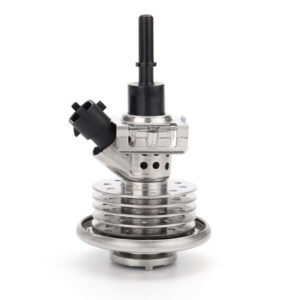
The DEF Injector (Dosing Valve)
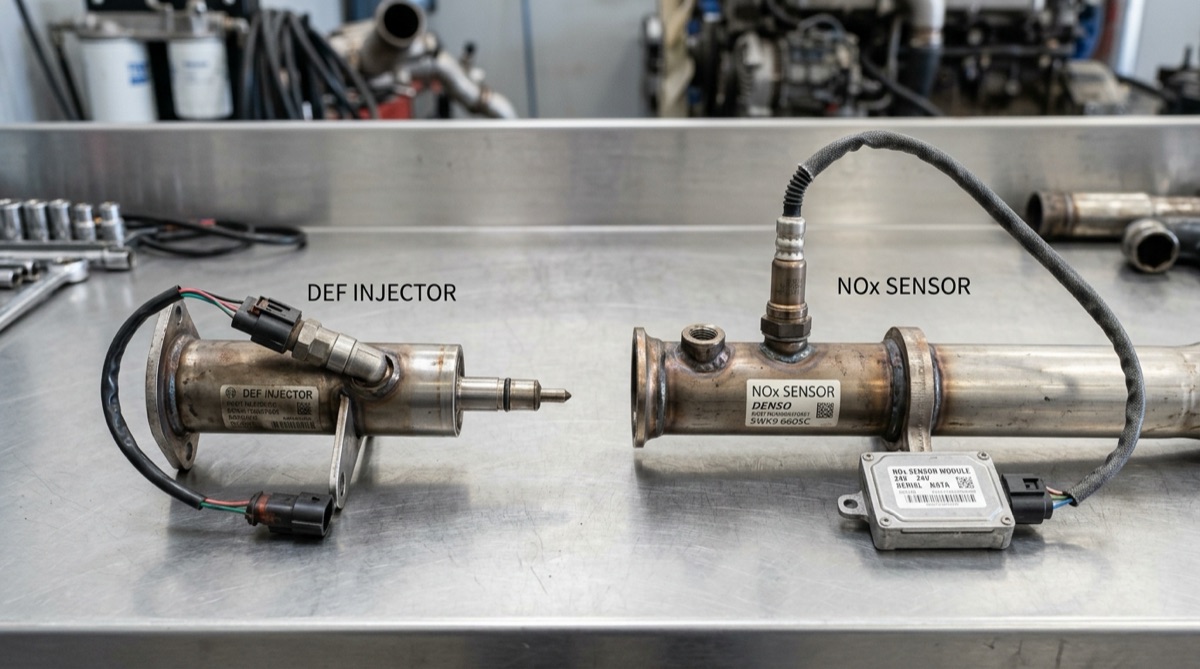
The injector is a mechanical/solenoid component. Its job is to spray a fine mist of DEF into the exhaust stream. It doesn’t “know” if it’s doing a good job; it simply follows the Pulse Width Modulated (PWM) commands of the ECM. If it is partially clogged with urea crystals, it might still spray, but the pattern will be poor, leading to large droplets that fall to the bottom of the exhaust pipe rather than atomizing. This results in inefficient NOx reduction at the catalyst.
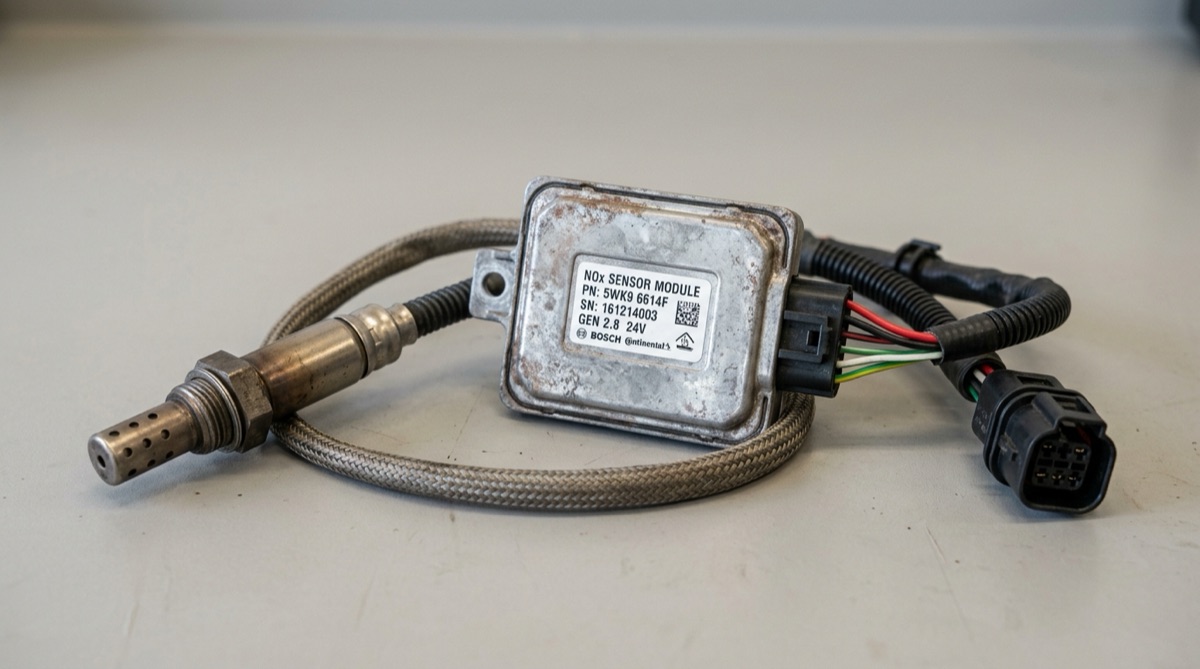
The NOx Sensor: The Electrochemical Lab
The NOx sensor is more than just a probe; it is a miniature electrochemical laboratory. It uses a ceramic element (Zirconia) and multiple pumping chambers to separate Oxygen from Nitrogen Oxide. It must reach temperatures of over 1200°F (internal heater) to function. Usually, there are two: an Upstream sensor (before the SCR catalyst) and a Downstream sensor (after). The Downstream sensor measures the “SCR Efficiency.” If the levels are too high, it tells the ECM that the system is failing.
The “Rationality Check” Logic
The ECM constantly performs a “Rationality Check.” It compares the readings from the Upstream and Downstream sensors. During a “Zero-Dose” event (when the injector is commanded to be OFF), both sensors should read exactly the same. If they don’t, the ECM knows a sensor has drifted. However, when the injector is ON, the ECM expects to see a 90% reduction in NOx at the downstream sensor. If that reduction doesn’t happen, the “Dilemma” begins: Is the injector not spraying, or is the downstream sensor lying?
Common P-Codes: Deciphering the Clues
While codes can overlap, certain DTCs point more strongly toward one component:
- P20EE (SCR NOx Adsorption Efficiency Below Threshold): This is the most common code. It means the downstream sensor sees too much NOx. This could be a “lazy” sensor or a clogged injector that isn’t providing enough DEF.
- P2201 (NOx Sensor Circuit Range/Performance): This points specifically to the sensor’s internal electronics. Often caused by moisture getting into the sensor’s control module (the metal box on the harness).
- P208A (Reductant Pump Control Circuit): Points toward the delivery system. If the pump can’t build pressure, the injector won’t spray.
- P2047 (Reductant Injector Circuit / Open): This is a hard electrical fault in the injector itself. It means the solenoid coil has failed or a wire is broken.
The “In-Service” Diagnostic Logic
When faced with an efficiency code (P20EE), follow this logical progression to isolate the fault:
Step 1: The Visual Inspection
Before touching a scan tool, remove the DEF injector from the exhaust pipe (but leave the lines and wires connected). Inspect the tip. If you see a “donut” of white crystals or a “stalactite” hanging from the nozzle, the injector is likely the culprit. This crystallization prevents the DEF from atomizing, meaning the liquid hits the catalyst as a stream rather than a mist, leading to “Cold Spots” and low efficiency.
Step 2: The Dosing Quantity Test
Using a professional-grade scan tool (like Cummins INSITE or Ford IDS), perform a “Reductant Quantity Test.”
- Place the injector into a graduated cylinder.
- Command the test (usually lasts 60 or 120 seconds).
- The Benchmark: Most systems should output between 80ml and 120ml per minute.
- If the volume is low: The injector or pump is faulty.
- If the volume is correct but the spray is a “stream”: The injector tip is worn or dirty.
- If the volume and spray pattern are perfect: The problem is likely the NOx sensor or the SCR catalyst itself.
Repair vs. Replace Maintenance Table
| Part | Cleaning Possible? | Typical Cost | Difficulty |
|---|---|---|---|
| DEF Injector | Yes (Warm water soak) | $200 – $500 | Easy |
| NOx Sensor | No (Rarely successful) | $400 – $800 | Moderate |
| DEF Lines | Yes (Flush with water) | $100 – $300 | Hard (Routing) |
| SCR Catalyst | No (Requires replacement) | $3,000+ | High |
FAQ: Diagnostic Dilemmas
Q: Can a bad NOx sensor cause the truck to use more DEF?
A: Yes. If the sensor is “reading high” (reporting more NOx than actually exists), the ECM will command the injector to spray more DEF to compensate. This not only wastes fluid but also leads to “Ammonia Slip” and accelerated crystallization.
Q: Why does my scan tool show “NOx Sensor Not Ready”?
A: NOx sensors have internal heaters that must reach over 1200°F to function. If the exhaust temperature isn’t high enough or the heater circuit is blown, the sensor will stay in a “Not Ready” state. This is often caused by a failed “Dew Point” calculation in the ECM.
Q: Can I clean a NOx sensor with brake cleaner?
A: NO. The chemicals in brake cleaner or WD-40 can permanently poison the ceramic element inside the sensor. Only use a soft brush to remove surface soot from the metal cage, or better yet, perform a high-temperature “regen” to burn off contaminants naturally.
Q: How often should I replace these parts?
A: Neither is a “scheduled” maintenance item. However, in heavy-duty applications, NOx sensors typically last 150,000 to 250,000 miles. DEF injectors can last the life of the vehicle if high-quality fluid is used and the filter is changed.
Q: Will a clogged DEF filter cause a NOx sensor code?
A: Indirectly, yes. A clogged filter reduces DEF pressure. Lower pressure means less DEF is injected, which leads to high NOx readings at the downstream sensor, triggering an efficiency code (P20EE).
Recommended Resources and Products:
- Internal Blog: Advanced SCR Troubleshooting Guide
- Related Product: Audi A8 3.0 TDI Urea Dosing Injector
- External Authority: NOx Sensor Technology Overview
- Technical Reference: Tenneco Emissions Control Systems