The Evolution of SCR Diagnostics
In the early days of Selective Catalytic Reduction (SCR) technology, diagnostics were relatively simple: if the DEF tank was empty, you filled it; if a sensor broke, you replaced it. Today, SCR systems have become incredibly complex, integrating dozens of data points from the engine, exhaust, and ambient air sensors. For a Master Technician, the challenge isn’t just reading a code; it’s understanding the *interoperability* of the system. We must look at how fuel trim, boost pressure, and exhaust backpressure all influence the efficiency of the NOx reduction reaction.
This guide moves beyond basic P-codes into the realm of advanced logic, signal analysis, and root-cause determination. We will explore how to diagnose “ghost” faults and SCR efficiency issues that leave standard technicians scratching their heads. For the professional mechanic, this is the blueprint for mastering the most misunderstood system on a modern diesel truck.
The “Golden Triangle” of SCR Health
To troubleshoot effectively, a technician must monitor the “Golden Triangle”—the three pillars upon which the entire SCR process stands:
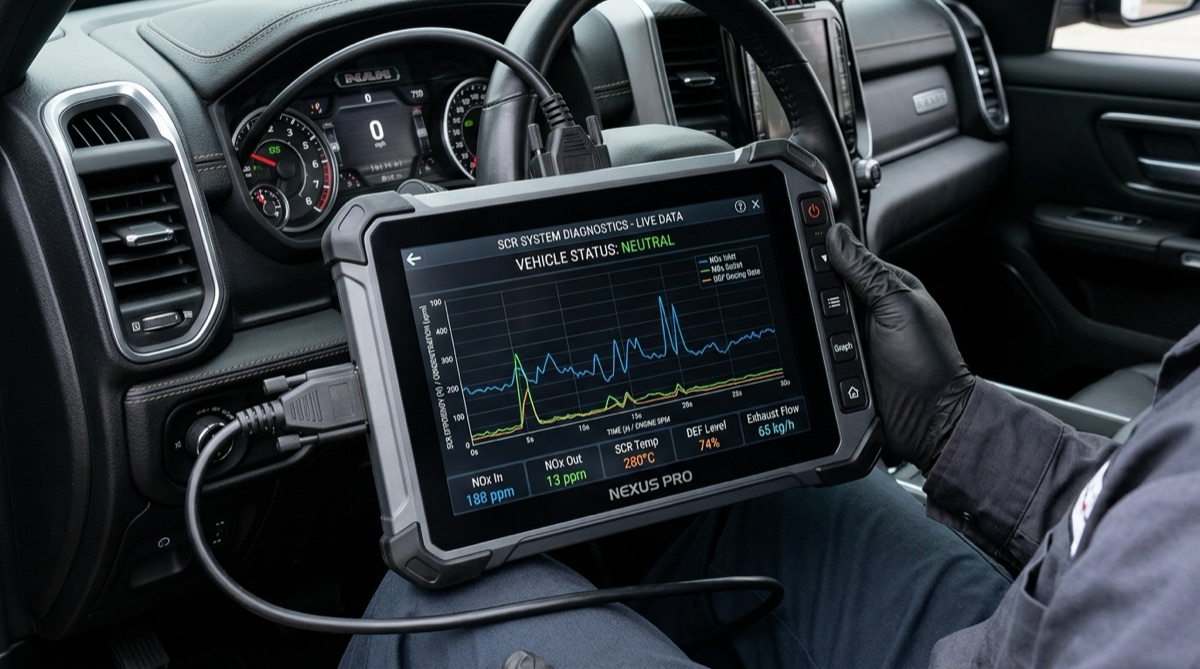
- NOx Reduction Rate: The delta between the upstream (pre-cat) and downstream (post-cat) NOx sensors. A healthy system achieves >95% reduction under load.
- DEF Pressure Stability: The dosing pump must maintain a consistent pressure (typically 5-9 bar). Any fluctuation here leads to poor atomization.
- Exhaust Temperature: The “Light-Off” temperature. The SCR catalyst does nothing below 200°C (392°F). If the engine can’t reach this temp, the system stays inactive.
If any one of these is “off,” the system fails. For example, if the exhaust temperature is too low (common in city driving or with a stuck-open thermostat), the DEF cannot undergo thermolysis into ammonia, leading to a “Low Efficiency” code even if every physical component is brand new.
Advanced Signal Analysis: NOx Sensors and PWM
A scan tool gives you a number, but an oscilloscope gives you the truth.
Pulse Width Modulation (PWM) Logic
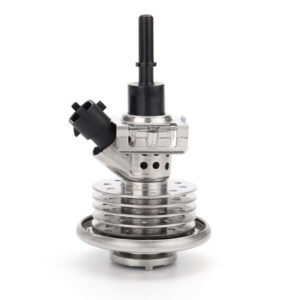
The DEF injector is not a simple on/off switch. It is controlled via Pulse Width Modulation. The ECM varies the “duty cycle” (the percentage of time the valve is open) to match the NOx output of the engine. A Master Tech uses an oscilloscope to verify that the PWM signal is clean. A “noisy” signal—often caused by a failing alternator or a bad ground—can cause the injector to “stutter,” leading to erratic dosing and phantom efficiency codes.
Reading the CAN Bus Architecture
Modern NOx sensors are “Smart Sensors,” meaning they contain their own control module and communicate with the ECM via the CAN bus (Controller Area Network). If you are seeing erratic or “frozen” data, check the voltage on the CAN high and CAN low lines. A fraying wire in the harness can introduce “packets” of incorrect data that the ECM interprets as high NOx levels, triggering a derate even when the tailpipe emissions are actually clean.
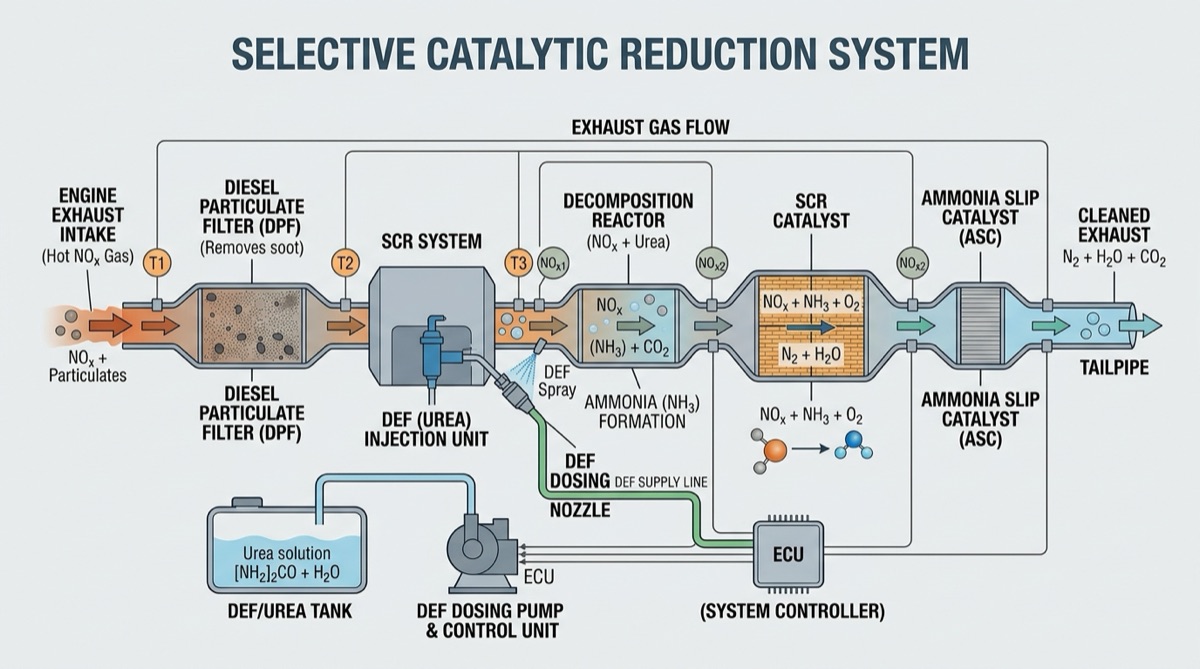
The Flow Diagram Logic: Isolating Blockages
Understanding the physical path of DEF is crucial for isolating hidden blockages.
Pressure Drop Analysis
When the system is primed, the pressure should be rock solid.
- Rapid Fluctuations: Indicates air is being sucked into the suction line or a failing pump check valve.
- Slow Pressure Build: Points to a clogged “Screen” filter in the tank header or a kinked line.
- Immediate Pressure Drop on Injection: This is a classic sign that the pump’s motor is weak; it has enough torque to build pressure but not enough to maintain “Flow Volume” once the injector opens.
Advanced P-Code Logic: Root Cause Detection
- P204F (Reductant System Performance): When this code appears without other faults, check for “Ammonia Slip.” This occurs when too much DEF is injected (perhaps due to a leaking injector), and the downstream sensor (which cannot distinguish between NOx and Ammonia) reads the excess ammonia as “high NOx.”
- P207F (Reductant Quality Performance): This isn’t just for “bad DEF.” It can be triggered by a faulty ultrasonic quality sensor or by a catalyst that has been “poisoned.” Silicon (from internal coolant leaks) or Phosphorus (from the wrong engine oil) can coat the catalyst, rendering it chemically inert.
Diagnostic Benchmarks Table
| Parameter | Healthy Value | Fault Indicator |
|---|---|---|
| SCR Efficiency | > 85% (at 250°C) | < 70% |
| Downstream NOx | < 15 PPM (at cruise) | > 50 PPM |
| DEF Pressure Stability | +/- 2 PSI variance | > 10 PSI Variance |
| Sensor Warm-up Time | < 120 Seconds | > 300 Seconds |
| Dosing Duty Cycle | 10% – 40% (Load dependent) | 0% or > 80% |
FAQ: Advanced SCR Diagnostics
Q: Can a failing turbocharger cause SCR codes?
A: Yes. If the turbo seals leak oil into the exhaust, the oil coats the SCR catalyst. This “poisoning” prevents the DEF from reacting with the NOx. This is a common root cause for persistent P20EE codes that new sensors won’t fix.
Q: What is “Ammonia Slip” and how do I detect it?
A: Ammonia slip happens when more ammonia is created than the catalyst can use. Because NOx sensors cannot distinguish between NOx and Ammonia, they report a “High NOx” value. If your NOx readings *increase* when you *increase* DEF dosing during a test, you have ammonia slip.
Q: Why does the system work fine on the highway but fail in the city?
A: Stop-and-go driving often fails to keep the exhaust above the 200°C “light-off” threshold. This leads to urea “puddling” and crystallization on the injector tip. The system isn’t broken; it’s just operating outside its design parameters.
Q: How do I verify a DEF quality sensor?
A: Use a manual refractometer to check the fluid. If your manual check shows 32.5% but the scan tool shows 25%, the ultrasonic sensor in the tank header is faulty and must be replaced.
Recommended Resources and Products:
- Internal Blog: Signs of a Malfunctioning Dosing Valve
- Related Product: Full SCR Product Catalog & Shop
- External Authority: DieselNet – SCR Technology for Diesel Engines
- Technical Reference: OBD-II Diagnostic Code Database