How Do I Know If My SCR Catalyst Is Bad?
The SCR catalyst is the most expensive component in your diesel truck’s aftertreatment system—and the one most drivers know the least about. When it fails, the symptoms mimic DEF injector problems, sensor faults, and even engine issues, making diagnosis difficult without the right approach.
The short answer: A bad SCR catalyst produces persistent P20EE or P20EF fault codes that do not clear after replacing the DEF injector. Other signs include a sulfur or ammonia smell from the exhaust, excessive soot accumulation, and progressive engine derate that worsens even after the DEF system is repaired. A bad catalyst cannot be cleaned or repaired; replacement is the only option, costing $2,500-$8,000 depending on the platform.
This guide explains how the SCR catalyst works, how to distinguish catalyst failure from DEF injector problems, and the exact diagnostic steps technicians use to confirm a bad catalyst before recommending replacement.
How the SCR Catalyst Works
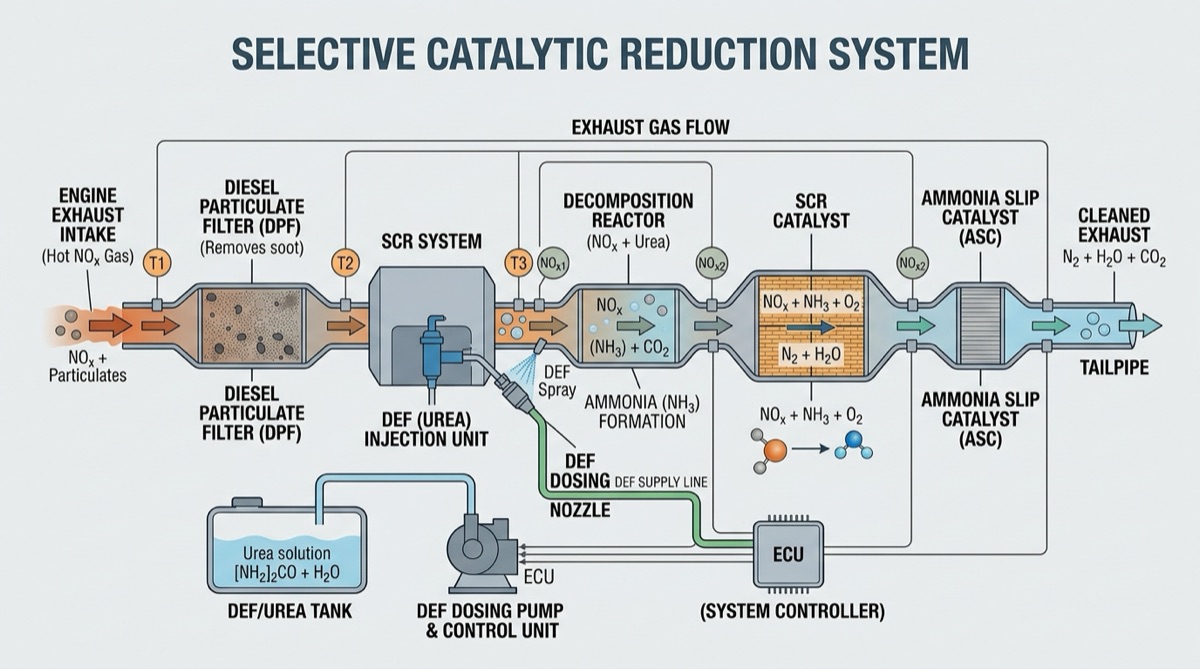
The Selective Catalytic Reduction (SCR) catalyst is a ceramic or metallic substrate coated with vanadium, zeolite, or copper-zeolite materials. Its job is to facilitate a chemical reaction between ammonia (from decomposed DEF) and nitrogen oxides (NOx) in the exhaust stream.
The reaction converts:
- NO (nitric oxide) + NH₃ (ammonia) → N₂ (nitrogen) + H₂O (water vapor)
- NO₂ (nitrogen dioxide) + NH₃ (ammonia) → N₂ (nitrogen) + H₂O (water vapor)
This process reduces NOx emissions by up to 95%, allowing diesel engines to meet EPA Tier 4, Euro 6, and equivalent standards. The catalyst itself is not consumed in the reaction, but it can be poisoned, contaminated, or physically damaged—rendering it ineffective.
5 Signs Your SCR Catalyst Is Failing
1. Persistent P20EE or P20EF Codes After Injector Replacement
The P20EE code (SCR NOx Catalyst Efficiency Below Threshold) is the most common indicator of catalyst problems. If you replace the DEF injector, clear the codes, and P20EE returns within 50-100 miles, the catalyst—not the injector—is the root cause. The code means the downstream NOx sensor is reading higher than expected, indicating the catalyst is not converting enough NOx despite receiving adequate DEF.
2. Ammonia Smell from the Exhaust
A healthy SCR catalyst consumes virtually all ammonia during the reaction. If you smell a sharp, pungent ammonia odor from the tailpipe—especially under hard acceleration—the catalyst is saturated and cannot process the ammonia being injected. This condition, called “ammonia slip,” confirms the catalyst substrate has degraded.
3. Sulfur Smell and Blue-Gray Exhaust Smoke
A damaged catalyst allows unburned fuel and oil vapors to pass through. This creates a sulfur or rotten-egg smell and may produce visible blue-gray smoke. While some smoke is normal during DPF regeneration, persistent smoke indicates catalyst failure.
4. Excessive DPF Regeneration Cycles
When the SCR catalyst fails, the ECU cannot maintain proper emissions control. It compensates by altering fuel injection timing, which increases soot production. The DPF fills faster, triggering more frequent regenerations. If your truck regenerates every 100-200 miles instead of every 400-600 miles, suspect SCR catalyst degradation.
5. Progressive Engine Derate That Worsens Over Time
A failing DEF injector causes sudden derate. A failing SCR catalyst causes gradual derate that worsens over weeks or months. The ECU monitors catalyst efficiency continuously. As efficiency drops, the ECU progressively limits engine output to maintain compliance. Eventually, the truck enters permanent limp mode.
SCR Catalyst vs DEF Injector: How to Tell the Difference
Many symptoms overlap between a bad catalyst and a bad DEF injector. Use this comparison to narrow down the root cause:
| Symptom | DEF Injector Problem | SCR Catalyst Problem |
|---|---|---|
| P20EE Code | Clears after injector replacement | Returns after injector replacement |
| DEF Consumption | Too high or too low | Normal; system injects but catalyst fails |
| Exhaust Smell | Normal or slightly chemical | Strong ammonia or sulfur smell |
| Code Return Time | Immediate (within first drive cycle) | Gradual (days to weeks) |
| Visible Smoke | Usually none | Blue-gray smoke possible |
| DPF Regeneration Frequency | May increase slightly | Increases significantly (2-3x normal) |
How to Diagnose a Bad SCR Catalyst
Professional diagnosis requires a scan tool with live data capability. Here is the step-by-step process:
Step 1: Verify DEF System Function
Before blaming the catalyst, confirm the DEF system is working correctly:
- Check DEF level and quality.
- Verify the pump builds and maintains target pressure.
- Confirm the injector is dosing at the commanded rate.
- Ensure the DEF tank heater works (in cold weather).
If any of these components are faulty, fix them first and retest.
Step 2: Monitor NOx Sensor Readings
Using live data, compare upstream and downstream NOx sensor readings during normal driving:
- Healthy catalyst: Upstream NOx is high (300-800 ppm). Downstream NOx is low (0-50 ppm). Reduction efficiency is 90%+.
- Degraded catalyst: Upstream NOx is normal, but downstream NOx remains elevated (100-400 ppm). Reduction efficiency drops below 70%.
- Failed catalyst: Upstream and downstream NOx readings are nearly identical. The catalyst is doing nothing.
Step 3: Perform Forced Dosing Test
Using the scan tool, command the DEF injector to dose at a fixed rate (typically 200-300% of normal). Monitor downstream NOx:
- If downstream NOx drops significantly during the test, the catalyst still has some capacity but may be marginal.
- If downstream NOx does not drop, the catalyst is effectively dead.
Step 4: Check for Physical Damage
Remove the catalyst (or inspect via borescope) for:
- Melted or cracked substrate
- Oil or coolant contamination
- Soot plugging
- Physical impact damage
Any visible physical damage confirms the need for replacement.
What Destroys an SCR Catalyst?
Understanding the causes helps prevent premature failure:
1. Contaminated DEF
The leading cause of catalyst poisoning. Trace metals (iron, copper, zinc, calcium) in non-certified DEF coat the catalyst surface and block reaction sites. Once poisoned, the catalyst cannot be cleaned. Always use ISO 22241-compliant DEF.
2. Engine Oil or Coolant Contamination>/h3>
A failed turbo seal, cracked EGR cooler, or blown head gasket allows oil or coolant into the exhaust stream. These fluids coat the catalyst substrate and permanently reduce efficiency.
3. Excessive Soot from DPF Failure
When the DPF fails or regeneration is interrupted, massive amounts of soot enter the SCR catalyst. The soot plugs the catalyst pores, preventing exhaust gas from reaching the active coating.
4. Thermal Damage
Over-fueling during DPF regeneration can cause exhaust temperatures to exceed 750°C (1,382°F). The catalyst substrate melts or sinters, collapsing the internal structure.
5. Physical Impact
Road debris, collision damage, or improper handling during service can crack the catalyst housing or substrate.
SCR Catalyst Replacement Cost
| Vehicle Class | OEM Catalyst Cost | Aftermarket Cost | Labor | Total |
|---|---|---|---|---|
| Light Duty (Pickup) | $800 – $1,500 | $400 – $800 | $200 – $400 | $600 – $1,900 |
| Medium Duty (Delivery Truck) | $1,500 – $3,000 | $800 – $1,500 | $300 – $600 | $1,100 – $3,600 |
| Heavy Duty (Semi Truck) | $3,000 – $6,000 | $1,500 – $3,000 | $400 – $800 | $1,900 – $6,800 |
Warranty Note: SCR catalysts are covered under federal emissions warranty for 5 years/50,000 miles (light duty) or 8 years/80,000-100,000 miles (heavy duty). Coverage excludes failures caused by contaminated DEF, oil consumption, or physical damage.
Frequently Asked Questions
Can a bad SCR catalyst be cleaned?
No. Once the catalyst substrate is poisoned or contaminated, cleaning is not possible. The active coating is applied at the molecular level, and no solvent or process can restore it.
How long does an SCR catalyst last?
Under normal conditions, 300,000-500,000 miles for heavy-duty trucks and 150,000-250,000 miles for light-duty pickups. Contaminated DEF, oil consumption, or DPF problems can destroy a catalyst in under 50,000 miles.
Can I drive with a bad SCR catalyst?
You can drive short distances, but the ECU will progressively derate the engine. Eventually, the truck enters limp mode. Operating with a failed catalyst also violates federal emissions regulations.
Will a bad SCR catalyst cause DPF problems?
Yes. The ECU compensates for poor NOx reduction by altering fuel injection timing, which increases soot production. This overloads the DPF and leads to more frequent regenerations.
Can I replace just the catalyst substrate?
On some heavy-duty platforms, the catalyst is a cartridge that can be replaced inside the housing. On most light-duty and medium-duty vehicles, the entire aftertreatment assembly must be replaced.
How do I prevent SCR catalyst failure?
Use only certified DEF, fix oil or coolant leaks immediately, maintain the DPF properly, and address DEF injector problems before they damage the catalyst.
Does a bad catalyst affect fuel economy?
Yes, indirectly. The engine derate reduces power, forcing the driver to use more throttle. Additionally, excessive regenerations consume extra fuel.
Can a faulty NOx sensor mimic catalyst failure?
Yes. A drifting or failed NOx sensor can report incorrect efficiency readings. Always verify sensor accuracy before condemning the catalyst. Swap upstream and downstream sensors temporarily to isolate the problem.
Is SCR catalyst replacement covered by warranty?
Yes, under federal emissions warranty. Light-duty vehicles: 5 years/50,000 miles. Heavy-duty vehicles: 8 years/80,000-100,000 miles. Exclusions apply for contamination and physical damage.
Where can I buy a replacement SCR catalyst?
Browse our DEF and aftertreatment system catalog for OEM and aftermarket SCR catalysts, DEF injectors, and complete dosing modules.
Conclusion
A bad SCR catalyst is one of the most expensive failures in a modern diesel aftertreatment system. The key to avoiding it is preventive maintenance: use certified DEF, fix engine problems that contaminate the exhaust, and address DEF injector faults before they poison the catalyst.
If you suspect catalyst failure, do not guess. Use live data to compare upstream and downstream NOx readings, verify the DEF system is functioning, and inspect for physical damage. Accurate diagnosis prevents the costly mistake of replacing a $400 injector when the real problem is a $4,000 catalyst.
For more aftertreatment system diagnostic guides, visit our complete SCR and DEF resource library.